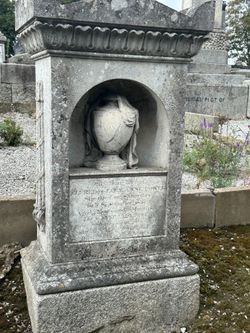
 Sir Alfred Power (February 1, 1805 - June 7, 1888) was a prominent 19th-century British civil servant, public administrator, and legal reformer best known for his extensive
work in shaping poor law administration both in England and Ireland.
Sir Alfred Power (February 1, 1805 - June 7, 1888) was a prominent 19th-century British civil servant, public administrator, and legal reformer best known for his extensive
work in shaping poor law administration both in England and Ireland.
Queer Places:
University of Cambridge, 4 Mill Ln, Cambridge CB2 1RZ
35 Raglan Rd, Ballsbridge, Dublin, D04 FH50, Ireland
Mount Jerome Cemetery and Crematorium, 158 Harold's Cross Rd, Harold's Cross, Dublin, D6W HY98, Ireland
Sir Alfred Power (February 1, 1805 - June 7, 1888) was a prominent 19th-century British civil servant, public administrator, and legal reformer best known for his extensive
work in shaping poor law administration both in England and Ireland.
He was the son of a physician and the younger brother of Joseph Power (who served as Librarian of the University of Cambridge and fellow of Clare College).
Educated at Repton School and initially entered Clare College, Cambridge, before migrating to Downing College, Cambridge.
Excelled academically, achieving success in both the Mathematical and Classical Triposes, graduating as 2nd Classic and earning his Bachelor of Arts (BA) in 1826.
Subsequently elected a Fellow of Downing College.
Called to the bar as a barrister of the Middle Temple.
Appointed as one of the factory commissioners in 1833 to investigate labor conditions in textile mills, contributing to the data underlying early landmark factory legislation.
Played a vital role in implementing the contentious Poor Law Amendment Act of 1834 across England, helping enforce administrative standardization.
Crossed over to Ireland, where he served as the Chief Commissioner of the Irish Poor Law and later as the vice-president of the Irish Local Government Board, steering relief systems and public health administration through decades that included the harrowing years of the Great Famine.
Alfred was also related to other prominent figures of the era, such as his brother Joseph Power. Within elite intellectual circles of 19th-century Cambridge, the broader Power family connection intersects with the intellectual lineage of the Cambridge Apostles.
While Sir Alfred Power himself navigated a traditional Victorian public career path, the Cambridge Apostles during and immediately after his generation became famously known as a hotbed for homosocial and homoerotic intellectual intimacy, eventually evolving by the late 19th and early 20th centuries (through figures like Lytton Strachey, John Maynard Keynes, and E.M. Forster) into a foundational intellectual circle for early modern LGBTQ culture and British queer history.
Academic analyses linking figures from Downing and Clare colleges of that era often highlight how these elite, homosocial collegiate networks fostered intense emotional and intellectual bonds among men, mirroring the complex shifting boundaries of private affection and public morality in Victorian academia.
References:
 The Cambridge Apostles, 1820-1914: Liberalism, Imagination, and Friendship in British Intellectual and Professional Life 1st Edition by W.C. Lubenow |
Other references:
Support this project
This website is a passion project researched, developed, and funded entirely by me. If you find the content valuable and would like to help support the ongoing research and hosting costs, any contribution is deeply appreciated.
Thank you for keeping this independent resource alive!
My books on Amazon: Elisa Rolle's books